


The emergence and spread of bacteria associated with antimicrobial resistance (AMR) is a major global public and animal health problem. The World Health Organisation estimates that, if the situation is not brought under control quickly, AMR could become the leading cause of death worldwide by 2050, ahead of certain chronic diseases such as cancer.
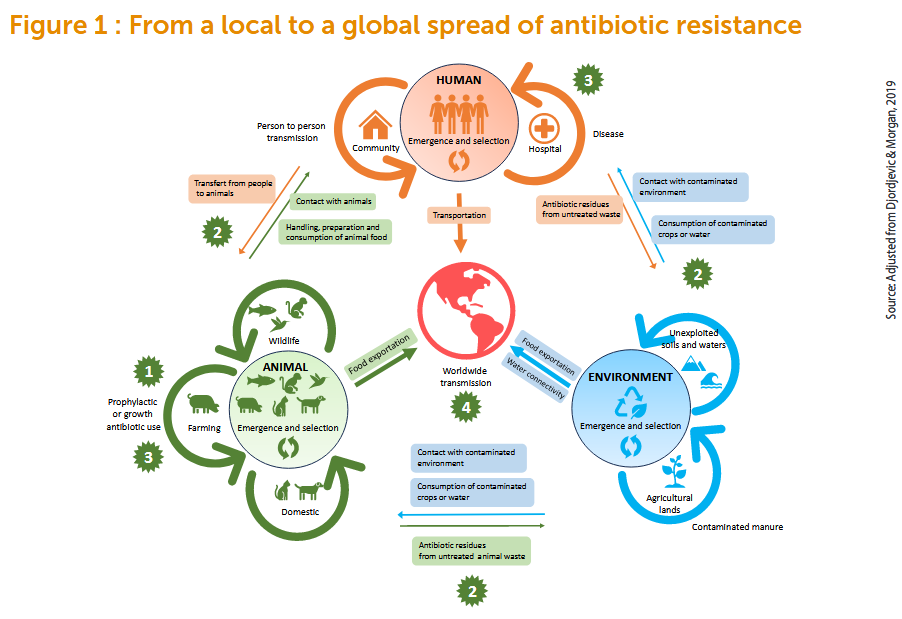
AMR is also an environmental problem, characterised by complex interactions involving various microbial populations and affecting human health, animal health and the environment. Furthermore, the phenomenon of AMR is closely linked to broader issues such as climate change, health crises and inequalities in access to healthcare.
It therefore makes sense to address this phenomenon of resistance by taking this complexity into account, using a coordinated, multi-sectoral approach, as recommended by the One Health’ strategy, which integrates humans, animals and the environment. This One Health approach, applied to the spread of AMR, is all the more relevant given that it is estimated that 75% of emerging or re-emerging infectious diseases in humans over the last few decades are of zoonotic origin.
Given the urgency of the situation, the main regional and interregional players involved in the fight against AMR and in the ‘One Health’ approach — IRD, CNRS, Ifremer, CIRAD, the University of Montpellier, Paul-Valéry University of Montpellier, Lyon 3 University of Social Sciences and Humanities, Gret France, the Mérieux Foundation, the Faculty of Medicine and Montpellier University Hospital — have developed a Policy Brief advocating for the fight against AMR through a ‘One Health’ approach. The aim of this document is to explain and convince, based on data from scientific literature, of the urgency of the AMR issue and the need to provide solutions through a ‘One Health’ approach. Through concrete recommendations, the goal of the main actors is to help decision-makers take informed action.
This document was sent to the France–AMR mirror group and to the public authorities involved in this issue, particularly during World AMR Awareness Week (18 to 24 November 2025). This Policy Brief was also given to ASEAN ministers and members, as well as other French participants at the One Health Conference held on 25 and 26 November 2025 in Jakarta.
Finally, on 7 April 2026, on World Health Day, France will host the One Health Summit in Lyon. This advocacy will be communicated to all key players in the public and private sectors, academia, international organisations, international donors, local authorities and civil society, whose common objectives will be:
i) to transform commitments into concrete actions ;
ii) to propose innovative solutions ;
iii) and build lasting cooperation for the health of all: humans, animals, plants and the planet.
To know more
https://umr-marbec.fr/wp-content/uploads/2026/01/Banuls-2025-AMR-Policy-brief.pdf
https://www.consilium.europa.eu/fr/infographics/antimicrobial-resistance
https://www.anses.fr/fr/content/one-health-une-seule-sante-pour-les-etres-vivants-et-les-ecosystemes
https://www.woah.org/fr/evenement/semaine-mondiale-dinformation-sur-la-ram-2025
Contact
Jean-Christophe AUGUET (CNRS, MARBEC), co-author of the Policy Brief.